
The Astromundi Cluster, also known as the Shattered Sphere or Clusterspace, is an isolated crystal sphere that is home to the ASTROMUNDI CLUSTER Campaign Setting.[1]
Overview
The Astromundi Cluster is unique among crystal spheres in that it lacks planetary-sized masses. Instead, the Cluster is filled with planetoids, asteroid belts, man-made habitats and other interesting features. Isolated and secluded, the Cluster is not a forgiving place; ships that enter Clusterspace sometimes never leave, unable to escape from a crystal sphere that was more than willing to let them in. On top of that, there are a number of different power groups within the Astromundi Cluster, each with its own goals and means of achieving its ends.[4][5]
Location
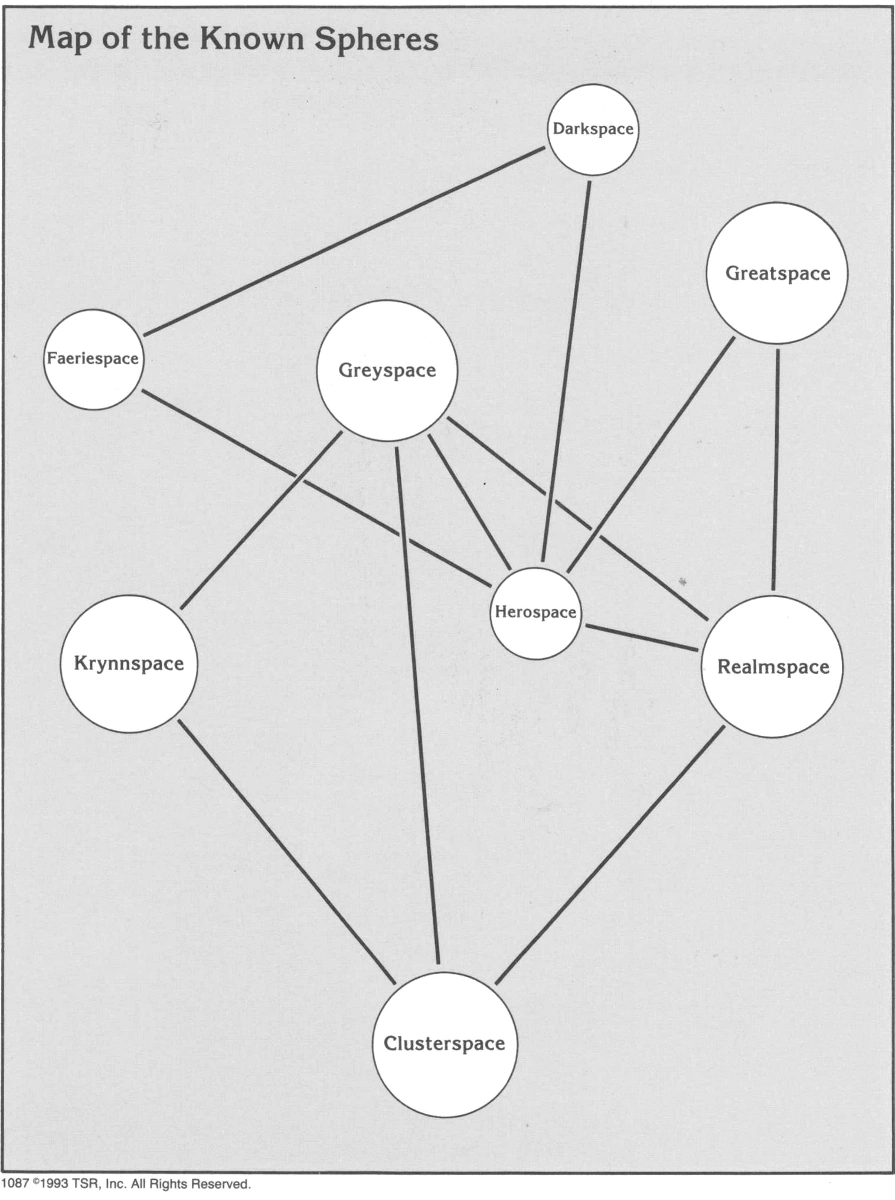

Map of the Known Spheres
Clusterspace is a free floating crystal sphere in the Flow, and has connections to Realmspace, Greyspace, and Krynnspace.[6]
Celestial bodies
The Astromundi Cluster is a heliocentric system, with the system primary, a fire body known as Firefall, lying at the center of the sphere and orbited by thousands upon thousands of celestial objects, including a variety of asteroids, planetoids, comets and nebulae.[4] Below are listed the major asteroid fields and the more notable colonies, and their satellites.[7]
Firefall (Sun)
Firefall is the primary sun of Clusterspace, and is a size I cluster of variously colored fire bodies. It is named for its unique configuration of rising and falling spheres of flame.[8]
Islands of the Sun
The asteroid belt known as the Islands of the Sun is located between the Cluster's two suns. Since the location is intolerably hot, most believe that only fire elementals and the like could live there, but rumors persist that the Sun Mages have built magically protected fortresses here as a fallback position in case they need to retreat during times of war.[8]
Denaeb (Sun)
Denaeb is the secondary sun of the Astromundi Cluster, and is an exquisite sapphire-colored size G spherical fire body that has a steeply inclined orbit. The light from Denaeb is not as bright as that of the primary, but it is no less beautiful or inspiring.[8]
The Shakalman Group
The Shakalman Group is a size C cluster of earth bodies that, despite being nearly uninhabitable due to the extreme heat and lack of water, serves as an important Antilan ship-building facility, where they build their crystal ships and crystal citadels.[8][9]
Barukhaza
Barukhaza is a size B irregular earth body that was at one time the most profitable mine in Clusterspace.[8][10]
The Golden Girdle
The Golden Girdle is the center of the Antilan Empire. The richest and most hospitable asteroid belt in Clusterspace, it boasts plentiful natural resources, including water, sunlight, and plenty of earth to build and farm on. To further cement their power within the Girdle, the Antilans have constructed three artificial worlds which orbit in a triangular formation around the primary, named Kashimar, Tan-Sharm, and the Imperial capital, Mu-Thalak.[11][12]
The Tumara Cloud
The Tumara Cloud is a size C irregular air nebula that serves as an Antilan naval base, where they build and repair their crystal ships.[13]
Malishan
Malishan is a size C cluster of water and earth bodies used by the Antilans as a watering post and staging area for local invasions.[13]
Dumovian
Dumovian is a size D cluster of earth bodies used by the Sun Mages to breed slaves.[13]
Mordan
Mordan is a size G spherical air body that has three major moons, named Sharya, Thuma, and Iatan.[13]
Shaseogan
Shaseogan is a size A irregular earth body and is used by the neogi to monopolize trade with the Inner Ring.[13][14]
The Inner Ring
The Inner Ring is a heavily-populated asteroid belt at the heart of the Astromundi Cluster. Virtually every known race is represented here in some form (with the notable exception of the beholders), and trade is fast and furious. By universal agreement, open hostilities is banned within the Inner Ring.[13][15][7]
Illiman
Illiman is a size B irregular water body that is littered with neogi temples and settlements.[16]
Chakarak
Chakarak is a size B irregular earth body, and is a newly established dwarven colony.[17][18]
The Varan Group
The Varan Group is a size D cluster of earth bodies. As one of the largest terrestrial bodies in the Cluster, the Group is home to a number of Varan warlords, and various illithid fortresses and/or outposts.[17]
Ushathrandra
Ushathrandra is a size F spherical air body that is held stationary by powerful magic cast by the illithids. The gas giant has three moons, named Darkwatch, Talos, and Ilimandara, that are kept frozen in place in the eternal shadow cast by the planet, and serve as the seat of the illithid empire.[17][19]
Deyomad
Deyomad is a size F spherical air body surrounded by a dense ring system, and is the home-world of the various beholder races.[17]
The Glacier
The Glacier is an asteroid belt primarily composed of frozen ice and cold earth bodies. The Calidians have established a few trade cities, and export water to colonies where there is a shortage.[17]
The Dark Group
The Dark Group is composed of five size C asteroid clusters that are all that remain of one of the worlds destroyed in the First Cataclysm. The Dark Group asteroid clusters are named Achemon, Torin, Khel, Lumura, and Mitiar.[17][20]
Calimar
Calimar is a size G spherical air body that has three moons of considerable size, named Sultamar, Calamed and Amaron.[17][21]
Thandilan
Thandilan is a size C spherical earth body, where the Calidians have established a prosperous farming kingdom.[22]
Boyarny
Boyarny is a size C cluster of earth bodies that is used by the Varan and their Thoric partners as a trading post.[22][23]
Sargasso of Skulls
The Sargasso of Skulls is a size D magic-dead zone obscured by purplish clouds and surrounded by a ring of strange skulls which define its perimeter.[22]
Avarien
Avarien is a size C cluster of tangled vines and clods of earth. This liveworld is home to a large settlement of reclusive elves.[22][24]
Tronsogard
Tronsogard is a size B cluster of earth bodies and is a remote Thoric settlement inhabited mostly by explorers and traders.[22]
Drachengard
Drachengard is a size C cluster of water bodies, and is a remote Thoric settlement that has become a haven for adventurers and other mercenaries.[22][25]
Trinona
Trinona is a size F spherical air body with two tenuous ring systems and a large moon named Netune. The Grand Duchy of Trinona's staggering success and hardy defenses has quickly made it one of the Calidian mercantile powerhouses.[22]
Cerekazadh
Cerekazadh is a size C irregular earth body, and is the largest dwarven nation in the Cluster. The entire surface has been covered with fortifications and living quarters for non-dwarves in order to encourage trade between the various races.[26][27]
Ssthakal
Ssthakal is a size B cluster of water bodies, and is home to a settlement of lizardfolk.[26]
Giltiond
Giltiond is a size B liveworld made up of a single huge vine growing around numerous asteroids and sizable balls of ice.[26]
Ironport
Ironport is a size A pyramid-shaped earth body that is used by the neogi as a trade base.[28][29]
The Great Belt
The Great Belt is a heavily populated asteroid belt composed of earth, water and ice bodies.[28]
Isle of Banshees
The Isle of Banshees is a size A irregular earth body inhabited solely by undead sailors who perished while spelljamming within the Shattered Sphere.[28][30]
Doromakhad
Doromakhad is a size B irregular earth body that is home to a small dwarven mining colony which was recently attacked by bizarre, amoeboid creatures.[28]
Khalzan
Khalzan is a size C irregular water body and is the largest settlement of lizardfolk in Clusterspace.[28][31]
Dalmania
Dalmania is a size B irregular earth body and is home to a Calidian city-state which is one of the dominant powers in the outer regions of Clusterspace.[28][32]
Hatha
Hatha is a size B irregular ice body that is home to a handful of Thoric settlers who make their living by hunting the fur-bearing animals who share the iceball with them.[28][33]
Highport
Highport is a size A irregular earth body, and is the only Arcane-held spaceport in the Shattered Sphere.[34][35]
The Fringe
The Fringe is a sparsely populated asteroid belt.[34]
Additional astronomicals
The Maw
The Maw is a size B adult murderoid, and is classified as a liveworld.[28]
Phalangilon
Phalangilon is a size A irregular earth body, and is one of a handful of living asteroids within the Astromundi Cluster.[36]
The Shtokan Nebula
The Shtokan Nebula is a size D star-fish shaped nebula, composed primarily of water vapor and poisonous gases, and orbits the primary perpendicular (90°) to the ecliptic.[34]
Crystal sphere
The crystal sphere that surrounds Clusterspace is a very strange one. From within, the sphere is resistant to any spells that could be used to open portals to the Flow, but the shell itself can be breached simply by touching it with a living spelljamming craft, such as those used by the elves. These living ships may pass through the sphere's inner surface with no difficulty, but no other ship can, even if towed by a living ship. Note that there is no other way to exit the crystal sphere. From the Phlogiston, the Cluster's crystal sphere is as easy to pass through as a wall of mist. Ships approaching the crystal sphere can pass through quickly and with no difficulty, only to find they cannot escape.[37]
Planar magic
The Astromundi Cluster floats within a boundary region within the Flow where the barriers between the various planes of existence are quite weak. Thus, it is possible for creatures to pass through to the Inner planes with relative ease in and around the Astromundi Cluster.[38] Creatures travelling through the phlogiston within 1,000 miles (1,609 kilometers) of the crystal sphere can shift into the Ethereal plane simply by concentrating on their desire to do so for no less than twenty minutes. Of course, not many people are going to be travelling through the phlogiston and suddenly decide they want be in the Ethereal plane! The elves are aware of this effect, but, as with all elven secrets, they aren't telling.[39]
In addition, spells or magical items that interact with the other planes of existence operate at greater efficacy, though these effects are inconsistent and are often temporary. The result is that a particular spell's range or area of effect may be doubled when cast within the Cluster, and then, when cast a second time, the damage dealt or duration of the spell may be affected. In a nutshell, there is no telling just how the nature of Clusterspace will affect extra-dimensional magic at any given time.[39]
During the Second Cataclysm, and with the arrival of the Unbidden, several wizshades came together to erect powerful barriers against intrusion from the Outer planes, and the Abyss in particular.[39] Concerned by the threat posed to the Material plane by lower planer creatures, and the tanar'ri in particular, the wizshades decided to invest the crystal shell with some of their essence and a portion of their sentience. This resulted in the "selective exit" aspect of Clusterspace, as the crystal shell gained the ability to "screen" those beings wishing to leave the Cluster, thereby preventing a tanar'ri invasion of the Known Spheres.[37]
Though very powerful, these planar barriers do not affect the spell-granting powers of the gods. The wizshades who erected the barriers had neither the power nor the inclination to separate the gods from those who worshipped them. Unfortunately for priests, the barriers make it extremely difficult to contact or converse with an outer planar creature, and all but impossible for creatures in the Abyss. Thus, priests have no difficulty receiving spells from their deity, but may not be able to contact such divine beings due to the barriers which seal the Cluster off from the Outer planes.[39]
Finally, any creature that leaves the Shattered Sphere via the other planes of existence and subsequently returns to the Material plane will always find themselves back within the Cluster. The wizshades used their collective power to cast a powerful spell which binds the essence of those within the Cluster to the Material plane. In practical terms, this means that if someone within the Cluster uses a spell, such as plane shift, and successfully leaves the Material plane and enters another, no matter how far they move about on the other plane and no matter how many other planes they move through, when they return to the Material plane they will always appear in the exact location within the Cluster from which they had departed. Such is the nature of the crystal sphere surrounding the Astromundi Cluster.[40]
The Constellations
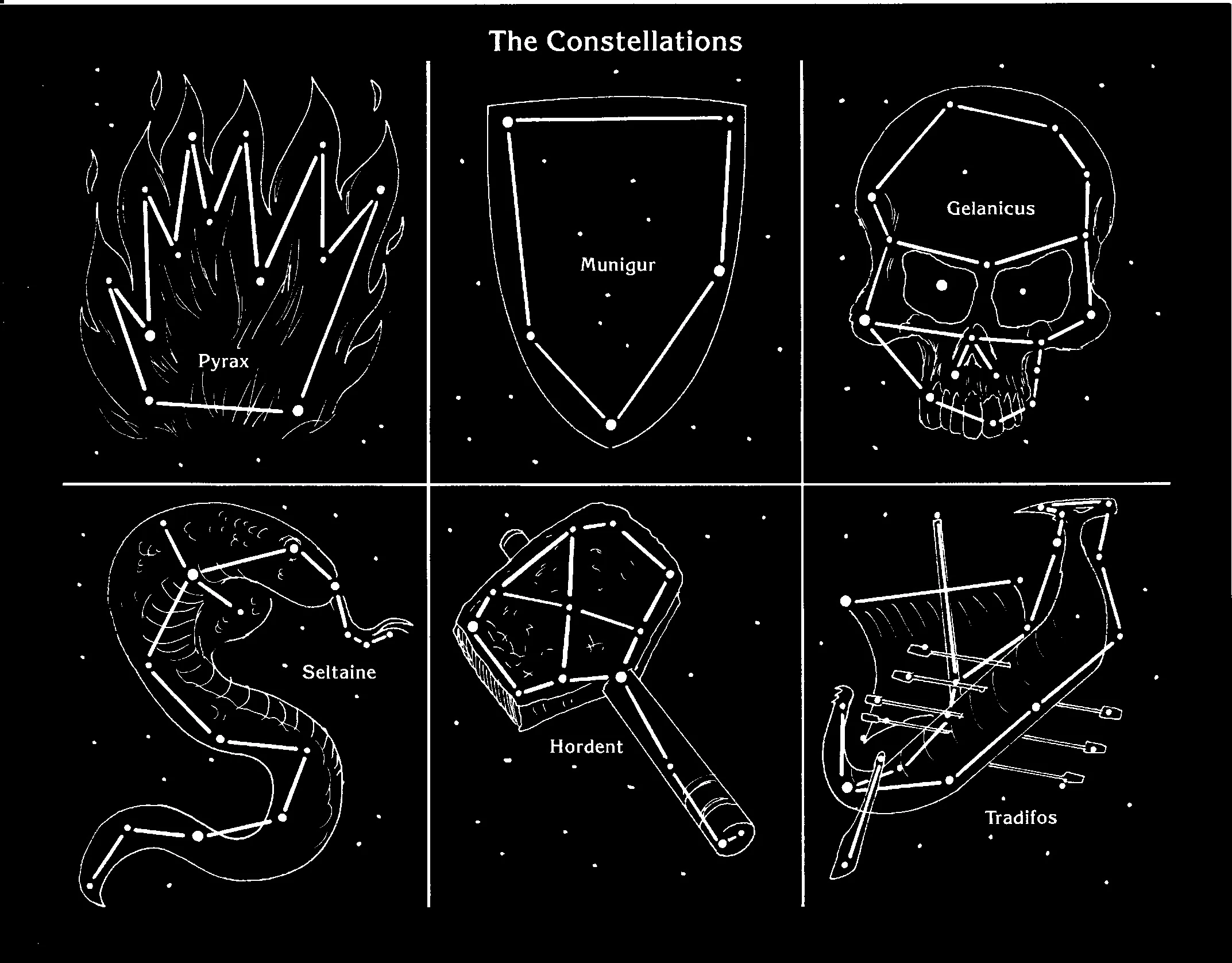

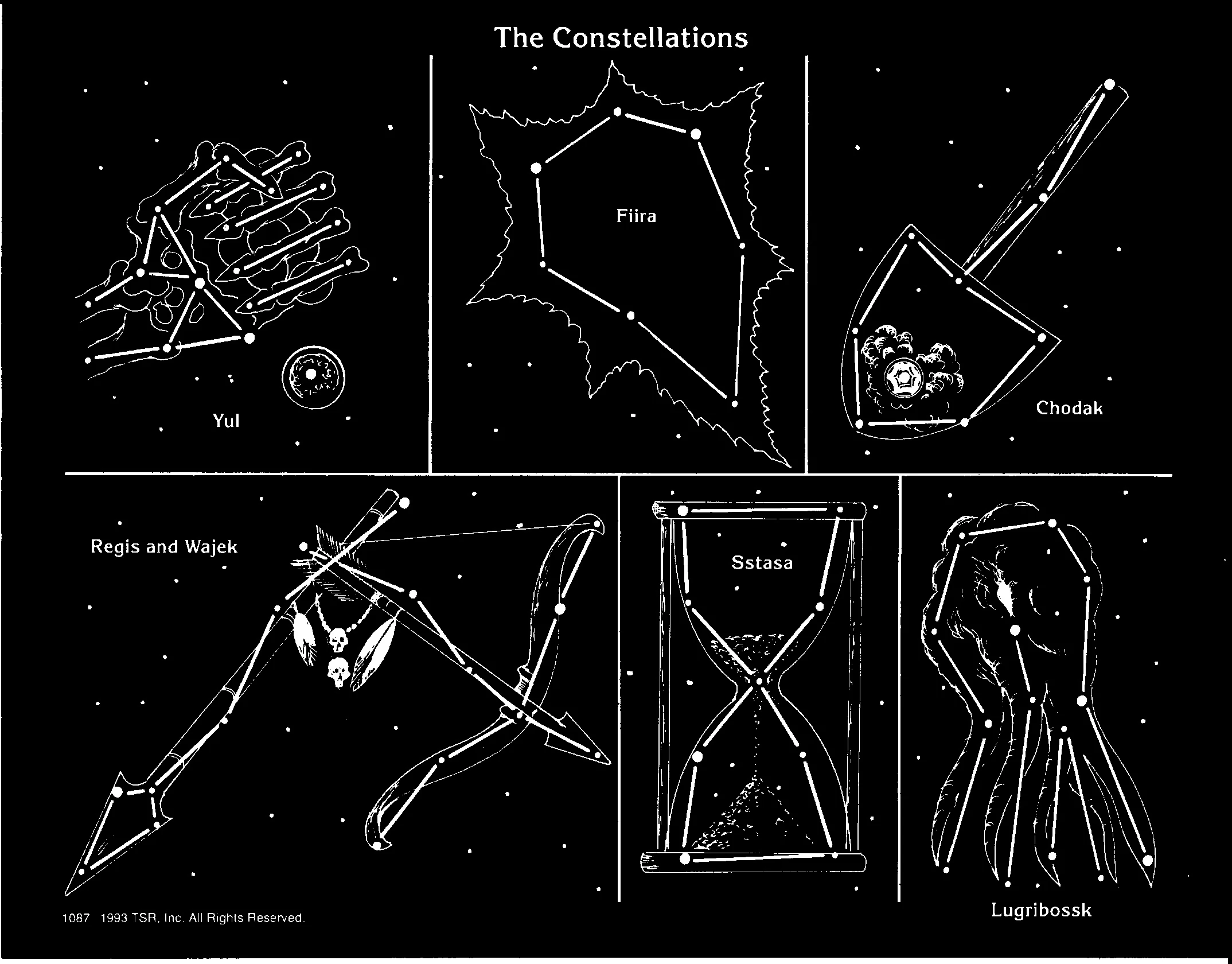

Constellations of the Astromundi Cluster
The Astromundi Cluster has a number of unique constellations which move around the interior of the sphere in a precise and ordered manner. Each of the constellations is made up of several brilliant stars, which are actually pillars of intense magical flames, mounted on top of towers that are propelled along the interior of the crystal sphere by unknown means. The age of the pillars and their means of creation is a mystery, though it is believed the constellations are the work of the gods and are as old as the Cluster itself.
The major constellations are arranged along the ecliptic, in a flat plane in line with the primary sun, Firefall. These constellations represent the thirteen deities of Clusterspace, and time within the Astromundi Cluster is measured by their movements. Each constellation moves a fixed distance during an Astromundi month, measured in relation to Firefall and the planets. Days are measured by the intensity of the constellation, which varies in eight hour cycles. During the morning watch, the constellations are exceedingly dim, and barely visible. They brighten over a period of eight hours, until they are nearly as bright as the secondary sun, Denaeb. At this time, the constellations begin to dim once more, going out altogether by the beginning of the Dark Watch.[34]
The thirteen constellations, in calendar order, are: Pyrax, Munigur, Gelanicus, Seltaine, Hordent, Tradifos, Yul, Fiira, Chodak, Regis, Wajek, Sstasa, and Lugribossk.[34]
Appendix
External Links
- Astromundi Cluster article at the Forgotten Realms Wiki, a wiki for the Forgotten Realms campaign setting.
- Clusterspace at Beyond the Moons (the official Spelljammer website)
References
- ↑ 1.0 1.1 Sam Witt, The Astromundi Cluster, 1993, (TSR Inc.), ISBN 1-56076-632-8
- ↑ Sam Witt, The Astromundi Cluster, 1993, (TSR Inc.), ISBN 1-56076-632-8, Planetary Display Map poster
- ↑ Sam Witt, The Astromundi Cluster, The Celestial Almanac, 1993, (TSR Inc.), Planetary Movement section, Clusterspace chapter, page 5
- ↑ 4.0 4.1 Sam Witt, The Astromundi Cluster, The Astrogator's Guide, 1993, (TSR Inc.), Celestial Features section, The Astromundi Cluster chapter, pages 14-20
- ↑ Sam Witt, The Astromundi Cluster, The Astrogator's Guide, 1993, (TSR Inc.), Factions of the Shattered Sphere section, The Astromundi Cluster chapter, page 7
- ↑ Sam Witt, The Astromundi Cluster, 1993, (TSR Inc.), ISBN 1-56076-632-8, Map of the Known Spheres reference card
- ↑ 7.0 7.1 Sam Witt, The Astromundi Cluster, 1993, (TSR Inc.), ISBN 1-56076-632-8, Primary Asteroids Chart reference card
- ↑ 8.0 8.1 8.2 8.3 8.4 Sam Witt, The Astromundi Cluster, The Astrogator's Guide, 1993, (TSR Inc.), Celestial Features section, The Astromundi Cluster chapter, page 20
- ↑ Sam Witt, The Astromundi Cluster, The Celestial Almanac, 1993, (TSR Inc.), The Shakalman Group section, The Almanac chapter, pages 73-77
- ↑ Sam Witt, The Astromundi Cluster, The Celestial Almanac, 1993, (TSR Inc.), Barukhaza section, The Almanac chapter, pages 21-23
- ↑ Sam Witt, The Astromundi Cluster, The Astrogator's Guide, 1993, (TSR Inc.), Celestial Features section, The Astromundi Cluster chapter, pages 19-20
- ↑ Sam Witt, The Astromundi Cluster, The Celestial Almanac, 1993, (TSR Inc.), The Golden Girdle section, The Almanac chapter, pages 42-45
- ↑ 13.0 13.1 13.2 13.3 13.4 13.5 Sam Witt, The Astromundi Cluster, The Astrogator's Guide, 1993, (TSR Inc.), Celestial Features section, The Astromundi Cluster chapter, page 19
- ↑ Sam Witt, The Astromundi Cluster, The Celestial Almanac, 1993, (TSR Inc.), Shaseogan section, The Almanac chapter, pages 77-79
- ↑ Sam Witt, The Astromundi Cluster, The Celestial Almanac, 1993, (TSR Inc.), The Inner Ring section, The Almanac chapter, pages 51-58
- ↑ Sam Witt, The Astromundi Cluster, The Astrogator's Guide, 1993, (TSR Inc.), Celestial Features section, The Astromundi Cluster chapter, pages 18-19
- ↑ 17.0 17.1 17.2 17.3 17.4 17.5 17.6 Sam Witt, The Astromundi Cluster, The Astrogator's Guide, 1993, (TSR Inc.), Celestial Features section, The Astromundi Cluster chapter, page 18
- ↑ Sam Witt, The Astromundi Cluster, The Celestial Almanac, 1993, (TSR Inc.), Chakarak section, The Almanac chapter, pages 31-34
- ↑ Sam Witt, The Astromundi Cluster, The Celestial Almanac, 1993, (TSR Inc.), Ushathrandra and Moons section, The Almanac chapter, pages 79-83
- ↑ Sam Witt, The Astromundi Cluster, The Celestial Almanac, 1993, (TSR Inc.), The Dark Group section, The Almanac chapter, pages 38-41
- ↑ Sam Witt, The Astromundi Cluster, The Celestial Almanac, 1993, (TSR Inc.), Calimar section, The Almanac chapter, pages 26-29
- ↑ 22.0 22.1 22.2 22.3 22.4 22.5 22.6 Sam Witt, The Astromundi Cluster, The Astrogator's Guide, 1993, (TSR Inc.), Celestial Features section, The Astromundi Cluster chapter, page 17
- ↑ Sam Witt, The Astromundi Cluster, The Celestial Almanac, 1993, (TSR Inc.), Boyarny section, The Almanac chapter, pages 23-25
- ↑ Sam Witt, The Astromundi Cluster, The Celestial Almanac, 1993, (TSR Inc.), Avarien section, The Almanac chapter, pages 18-20
- ↑ Sam Witt, The Astromundi Cluster, The Celestial Almanac, 1993, (TSR Inc.), Drachengard section, The Almanac chapter, pages 41-42
- ↑ 26.0 26.1 26.2 Sam Witt, The Astromundi Cluster, The Astrogator's Guide, 1993, (TSR Inc.), Celestial Features section, The Astromundi Cluster chapter, page 16
- ↑ Sam Witt, The Astromundi Cluster, The Celestial Almanac, 1993, (TSR Inc.), Cerekazadh section, The Almanac chapter, pages 29-31
- ↑ 28.0 28.1 28.2 28.3 28.4 28.5 28.6 28.7 Sam Witt, The Astromundi Cluster, The Astrogator's Guide, 1993, (TSR Inc.), Celestial Features section, The Astromundi Cluster chapter, page 15
- ↑ Sam Witt, The Astromundi Cluster, The Celestial Almanac, 1993, (TSR Inc.), Ironport section, The Almanac chapter, pages 59-60
- ↑ Sam Witt, The Astromundi Cluster, The Celestial Almanac, 1993, (TSR Inc.), Isle of Banshees section, The Almanac chapter, pages 62-69
- ↑ Sam Witt, The Astromundi Cluster, The Celestial Almanac, 1993, (TSR Inc.), Khalzan section, The Almanac chapter, pages 69-70
- ↑ Sam Witt, The Astromundi Cluster, The Celestial Almanac, 1993, (TSR Inc.), Dalmania section, The Almanac chapter, pages 36-38
- ↑ Sam Witt, The Astromundi Cluster, The Celestial Almanac, 1993, (TSR Inc.), Hatha section, The Almanac chapter, pages 45-46
- ↑ 34.0 34.1 34.2 34.3 34.4 Sam Witt, The Astromundi Cluster, The Astrogator's Guide, 1993, (TSR Inc.), Celestial Features section, The Astromundi Cluster chapter, page 14
- ↑ Sam Witt, The Astromundi Cluster, The Celestial Almanac, 1993, (TSR Inc.), Highport section, The Almanac chapter, pages 46-51
- ↑ Sam Witt, The Astromundi Cluster, The Celestial Almanac, 1993, (TSR Inc.), Phalangilon section, The Almanac chapter, pages 70-73
- ↑ 37.0 37.1 Sam Witt, The Astromundi Cluster, The Celestial Almanac, 1993, (TSR Inc.), The Crystal Sphere section, Clusterspace chapter, page 3
- ↑ Sam Witt, The Astromundi Cluster, The Celestial Almanac, 1993, (TSR Inc.), Other Planes section, Clusterspace chapter, page 3
- ↑ 39.0 39.1 39.2 39.3 Sam Witt, The Astromundi Cluster, The Celestial Almanac, 1993, (TSR Inc.), Other Planes section, Clusterspace chapter, page 4
- ↑ Sam Witt, The Astromundi Cluster, The Celestial Almanac, 1993, (TSR Inc.), Other Planes section, Clusterspace chapter, page 5